4
min read
Sep 8, 2025
How Adidas Cut Content Publishing Time by 54% With Strapi and unified 5 CMSs into 1
.jpeg)
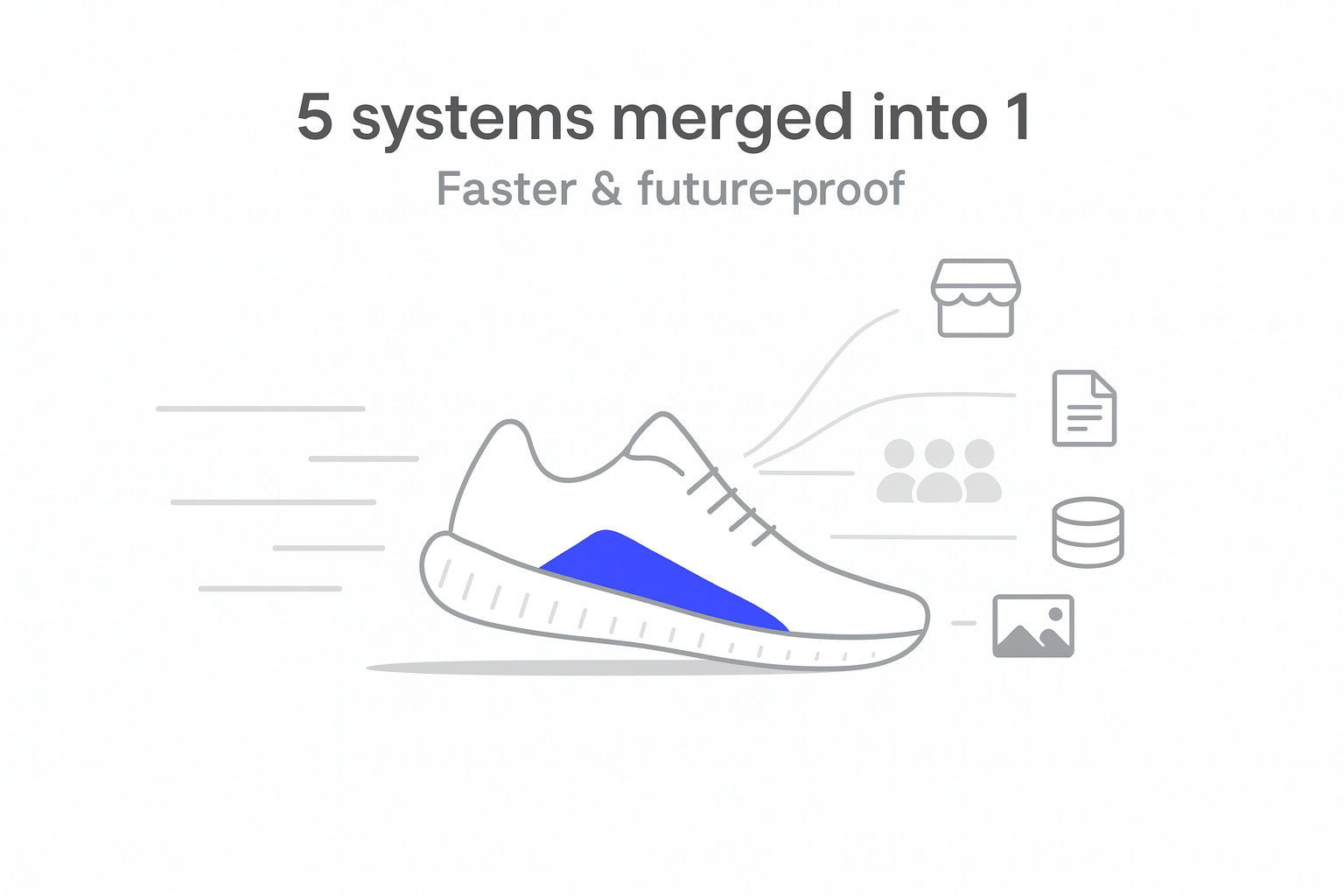
After more than 10 years with their existing CMS setup, Adidas found themselves in a mess:
Creating and managing global content became slow, fragmented, and expensive.
Adidas knew they needed a modern, scalable solution.
They started researching vendors, ran early discovery, and eventually shortlisted two top candidates. Strapi was one of them.
They then ran multiple PoCs, each focused on a specific internal use case.
Strapi came out on top. 🚀
Why?
Because it solved some problems out of the box, and for the rest, its API-first flexibility made it easy to build custom solutions.
This flexibility was key.
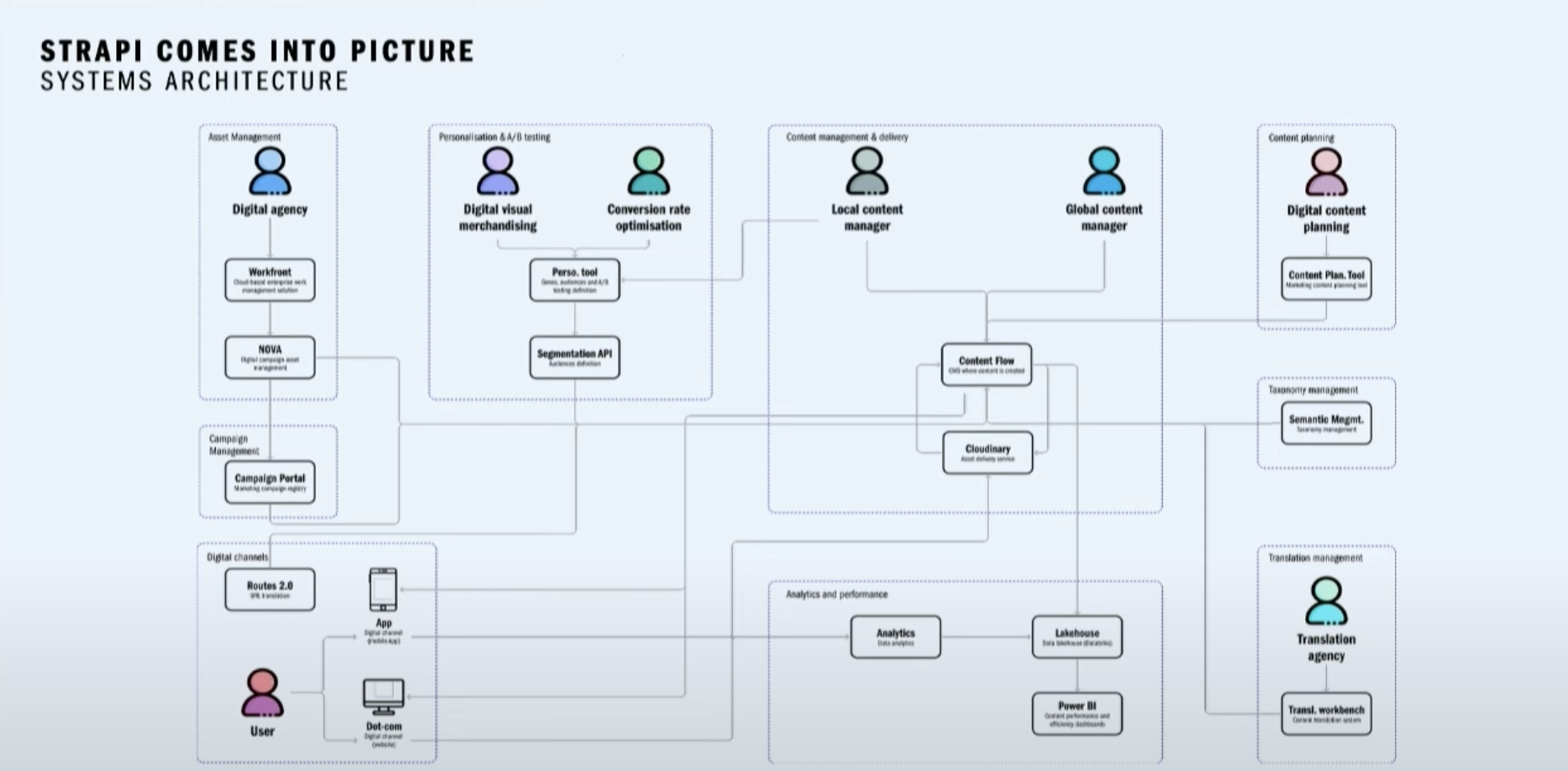
Adidas has a massive internal ecosystem with translation systems, admin portals, Cloudinary, asset pipelines, analytics, etc.
There was zero chance any off-the-shelf CMS would plug in seamlessly.
It was adaptable enough to become the connective tissue across all these systems.
After selecting Strapi, Adidas launched a 1-year transformation program called The Future of Content.
Unify the 5 legacy CMS systems and rebuild the way content is created, managed, and delivered globally.
✅ 54% faster publishing times
✅ Better targeting and personalisation (No more content silos)
✅ Deep analytics via Lakehouse and Power BI
✅ Faster experimentation and localisation
They did it all in-house.
It became a platform for collaboration across Adidas teams.
They opened internal contributions via pull requests, encouraging shared ownership across the other IT teams inside Adidas around the world.
Here’s what’s running today at Adidas:
To handle this load, they decoupled content management from content delivery
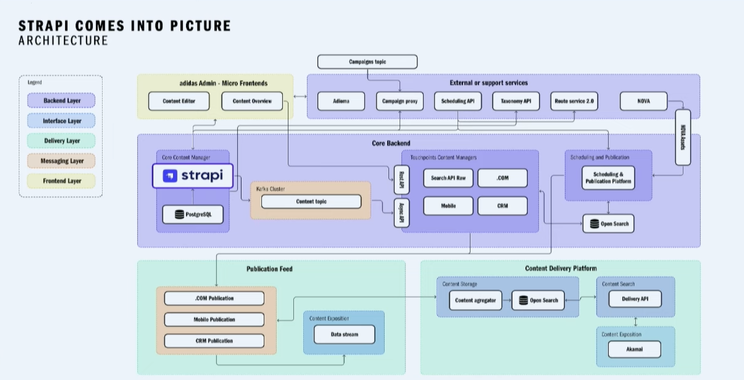
Adidas runs a fully event-driven architecture, powered by Kafka, with Strapi at the core handling content modelling.
They built a custom tool for content publication scheduling.
Because they publish hundreds of content items every day, often across multiple time zones.
This setup ensures global campaigns launch on time, without manual coordination.
Takes the raw content from Strapi and applies light transformations for each distribution channel:
Each channel gets tailored content without duplicating effort.
When they started (on Strapi v3), there was no built-in search across content types.
They built their own custom search layer to support unified querying across all collections inside Strapi admin.
They don’t use Strapi’s API directly for content delivery.
Instead, content is pushed to a separate high-availability platform, replicated across three regions.
The stakeholder architecture behind all this is highly complex
(See diagram below.)
Adidas chose Strapi because it strikes the right balance
Strapi solves key problems out of the box and stays flexible where custom solutions are needed. It integrates smoothly into complex ecosystems without forcing companies to conform to rigid structures.
That flexibility was critical. adidas runs dozens of internal tools, teams across time zones, and publishes to multiple touchpoints.
Strapi scaled with them, not against them.
It became the foundation of a system that now supports 10M+ publications, 31M daily requests, and content localised into 50 languages.
That’s exactly why we at Notum Technologies love Strapi too ❤️ It delivers where needed, adapts when necessary, and can truly handle the scale and complexity of global brands like Adidas.
The full talk is here, very nicely prepared from Guillermo Rodriguez and Fernando Gros González It deserves way more than 450 views!
https://www.youtube.com/watch?v=pjJNnW0UmgA
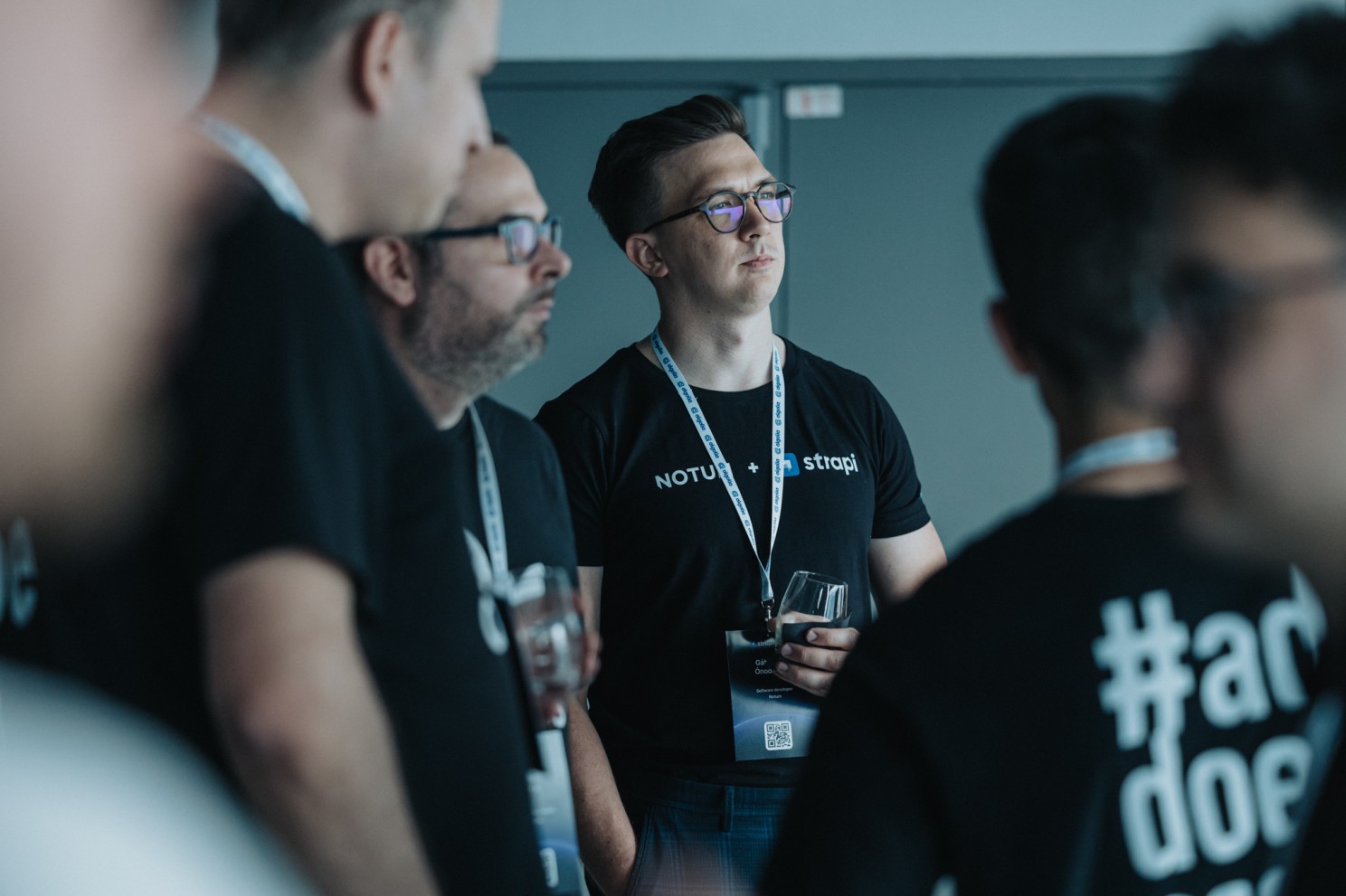
PS: It was great to meet you all at StrapiConf, thanks for sharing your journey!

Get our updates delivered directly in LinkedIn. No extra inbox, just your feed.



We’ll find out what your team needs, together. Book on Calendly.
Send us a message or schedule a call.
Discuss your needs in a 25 min free call.
Get a quote from us within 3 days.
You can also e-mail us at sales@notum.cz or book a meeting directly in our calendar.