From Twelve Websites to One Platform
+28%
Faster Interaction to Next Paint
85→100
SEO Health Score


Founded in Australia in 1986 Scenic Group operates two travel brands: Scenic Luxury Cruises & Tours at the ultra-luxury market, and Emerald Cruises & Tours at the premium end. Together, they take guests to over 100 countries across all seven continents through river cruises, ocean voyages, superyacht experiences, and handcrafted land journeys.
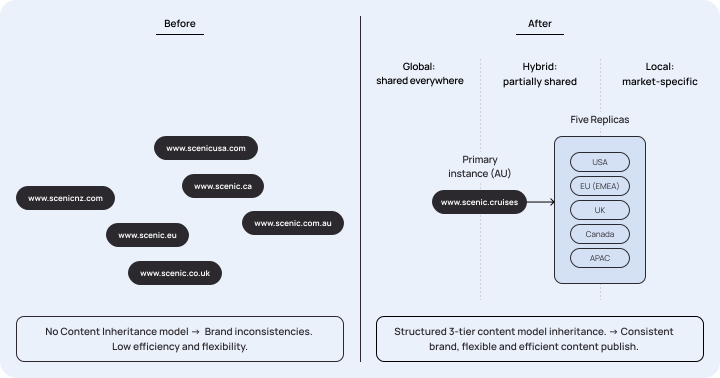
Both brands had grown into twelve separate regional websites, six per brand and a single language version only, all running on a legacy Sitecore CMS. Content had to be manually replicated across markets, with no language versions, no automation, and an increasingly expensive and slow publishing workflow. The platform blocked proper translation workflows, meaningful personalization, and fast campaign publishing.
The goal was to consolidate 12 sites into 2, building a platform where SEO authority, multilingual content, and regional publishing could work together without manual overhead, while significantly reducing total cost of ownership and removing dependence on a single vendor’s roadmap.
Notum built the platform from scratch on Strapi v5 and Next.js v15, hosted on Azure with Front Door handling all geo-routing and caching. Twelve domains were consolidated into two, with users automatically served the correct regional content based on location.

Rather than pure static generation, we implemented Incremental Static Regeneration, serving cached pages at CDN speed while keeping a short revalidation window open for real-time pricing and availability data. A separate SSR-backed preview environment runs alongside the production environment for editors, so content teams can review unpublished changes without touching the production cache.
The content model was built around three page types: global, hybrid, and local. Regional editors work in their own workspace with permission controls that give them full autonomy over their market without access to global content or other regions.

To handle read performance at scale, we stood up dedicated read only Strapi instances for each non-primary region, keeping the primary instance stable regardless of traffic elsewhere. This architecture, one authoritative writer surrounded by fast read-only replicas, is the foundation of the Strapi Kubernetes Plugin we have since productized, bringing the self-healing, elastic scaling, and zero downtime operation of Kubernetes to enterprise Strapi projects.
For translations, we built a custom Strapi translation connector from scratch. The integration is ready to support the upcoming multilingual rollout, and owning it means the translation provider can be swapped or extended as workflows evolve.
Delivering a project of this scope required coordinating across design, SEO, analytics, infrastructure, and content teams spanning Australia, Central Europe, and North America. Notum led that coordination end-to-end, keeping releases, decisions, and technical alignment moving among all parties throughout the project. Content migration ran in six sequential batches, one per region, each validated by the local market team before the next began.
That partnership continues post-launch, with Notum providing ongoing SLA-based support for both scenic.cruises and emerald.cruises.
Scenic Group is expanding the platform in several directions. Personalization for logged-in users is in development, tied to the Scenic & Emerald Rewards loyalty program integration. The platform is built to support five languages (UK English as master, US English, French, German, and neutral Spanish), with additional markets and languages activated progressively as the multilingual rollout proceeds. AI-assisted content generation inside Strapi is being explored as a future capability to help content teams with drafting, summarisation, and metadata generation. Migration of the Careers site and APAC microsite onto the same Strapi foundation is also planned.
Strapi is built to scale across multiple brands, regions, and languages from a single platform, for Scenic Group, that meant consolidating two brands and six regions into one platform, with the architecture ready to support five languages as the multilingual rollout progresses. Regional teams have full control over their own markets, while global content remains centrally governed through a structured permission model. With this migration, Scenic joined the likes of Tesco, Airbus, and IBM running Strapi in production at enterprise scale.
Sitecore’s licensing and annual maintenance costs are among the highest in the CMS market. For a group running twelve live sites, that overhead compounds fast. Strapi’s open-source Community Edition and predictable Enterprise plans offered a fundamentally different model, redirecting budget from platform maintenance into actual product development.
On Sitecore, even routine content updates required a developer ticket, a constant bottleneck for teams spread across six regions and multiple time zones. Strapi’s page builder puts that ownership back in editors’ hands, who can build pages, manage translations, and control regional workspaces without any development involvement.
With Strapi, you own your data, your codebase, and your hosting, with the freedom to deploy on any infrastructure you choose. For Scenic, that meant deploying on Azure on their own terms, with full control over configuration and no dependency on a vendor-managed environment. Sitecore’s model would have tied every decision to a single vendor’s release cycle. With access to 400+ plugins and open APIs, that flexibility extends to integrations as well. For Scenic, with a roadmap that includes personalization, the exploration of AI-assisted authoring, and further regional expansion, it was essential.
Strapi generates RESTful and GraphQL APIs out of the box on a modern Node.js stack, giving development teams full freedom over frontend framework and rendering strategy. For a project coordinating teams across Australia, Central Europe, and North America simultaneously, that mattered. Sitecore remains a heavy.NET monolith that requires specialized expertise and incurs significant overhead for any team maintaining or extending it.
We’ll find the solution that fits your needs.
We’ll find out what your team needs, together. Book on Calendly.
Send us a message or schedule a call.
Discuss your needs in a 25 min free call.
Get a quote from us within 3 days.
You can also e-mail us at sales@notum.cz or book a meeting directly in our calendar.
.png)